
Vacuum Lifting Equipment: A Practical Guide for South African Operations Managers
If your team is manually lifting heavy, awkward, or repetitive loads, you are paying for it — in injuries, in slow throughput, and in staff fatigue that compounds across every shift. Vacuum lifting is one of the most effective ways to engineer that problem out of your operation. This vacuum lifting equipment guide covers how it works, where it fits, and what to look for when specifying a system.
What is vacuum lifting?
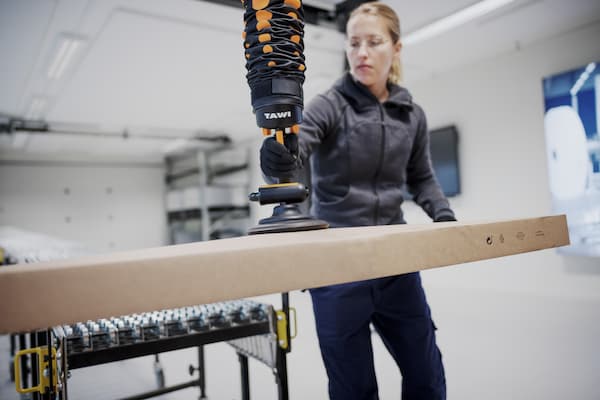
Vacuum lifting uses controlled suction to attach to a load and lift it — without the operator needing to grip, carry, or strain. The vacuum is generated either electrically or pneumatically, and the lifting capacity ranges from a few kilograms up to 270kg depending on the system.
The key advantage over a conventional hoist or crane is that vacuum lifters can handle a wide variety of load types — bags, boxes, drums, crates, glass, sheets, and more — and can tilt, rotate, and position loads precisely, not just lift them vertically. For production environments where loads need to be loaded onto machines, stacked at height, or turned through 90 or 180 degrees, this makes a significant practical difference.
Where vacuum lifting makes sense
Choosing the right vacuum lifting equipment starts with knowing where it fits — it works best where some or all of the following are true:
- Loads are smooth, flat, or consistently shaped enough for a suction cup to get a clean seal
- The same load type is handled repeatedly throughout a shift
- Operators are lifting above waist height, or at high frequency
- Manual handling injury risk is a documented concern
- Throughput speed matters and manual handling is a bottleneck
It is less suited to highly porous materials (like open-weave fabric) or irregularly shaped loads where a mechanical gripper or trolley attachment would get a more reliable hold.
Industries and applications
Vacuum lifting equipment is used across a wide range of South African industries:
- Food and beverage packaging — bags, boxes, crates, and multiple items simultaneously on high-speed lines
- Pharmaceutical manufacturing — precise, contamination-controlled handling of cartons and totes
- Brewing — kegs, drums, glass bottles, and crates in environments where drops are costly
- Chemical and industrial — drum and barrel handling, including explosion-proof systems for hazardous environments
- Automotive and manufacturing — sheet metal, components, and heavy panel handling
- Warehousing and logistics — order picking, palletising, and container loading and unloading
The main vacuum lifter types
High frequency vacuum lifters – Designed for rapid, repetitive handling of loads up to 65kg with a single hand. Best suited to high-speed packaging and order picking lines where speed and operator comfort are the priority.
Multifunction vacuum lifters – Interchangeable attachments allow the same unit to handle different load types across the same area. Can lift, spin, and rotate loads up to 270kg. The right choice for operations handling a variety of product types.
Mobile vacuum lifters – Floor-based units compatible with any forklift or pallet jack. Ideal for warehouse order picking and container loading where a fixed overhead system is not practical.
Stainless steel vacuum lifters – Manufactured to HACCP hygiene standards for food, pharmaceutical, and chemical environments. Fully washdown-safe.
Explosion-proof (ATEX) vacuum lifters – Specifically engineered for hazardous environments where flammable gases, vapours, or dust may be present.
Overhead crane and jib arm systems
A vacuum lifter needs something to hang from. TAWI crane and jib arm systems are designed to work with their vacuum lifter range, giving you flexible overhead coverage across a workstation or production area. If you already have overhead structure in place, a vacuum lifter can often be integrated directly — this is worth discussing with your supplier before specifying a new crane system.
Specifying the right vacuum lifting equipment: questions to ask first
Before getting a quote, have clear answers to the following:
- What is the maximum load weight you need to handle?
- What is the load shape and surface material (smooth, porous, irregular)?
- Do you need to tilt or rotate the load, or just lift and move it?
- How many lifts per shift are you doing?
- Is the environment food-grade, chemical, or potentially explosive?
- Do you have existing overhead structure, or do you need a crane system too?
- Are multiple load types handled in the same area?
TAWI vacuum lifting in South Africa
This vacuum lifting equipment guide wouldn’t be complete without a word on suppliers — SCHE is the primary South African distributor for TAWI vacuum lifting equipment, part of the Piab Group. TAWI’s range covers high frequency, multifunction, mobile, stainless steel, and ATEX systems, with custom attachments available for applications that don’t fit standard configurations. We have supplied vacuum lifting solutions to some of the most recognised manufacturing and logistics operations in South Africa.
If you have a specific application, we are happy to advise on the right system and configuration.
View our vacuum lifting equipment | Contact us for a specification